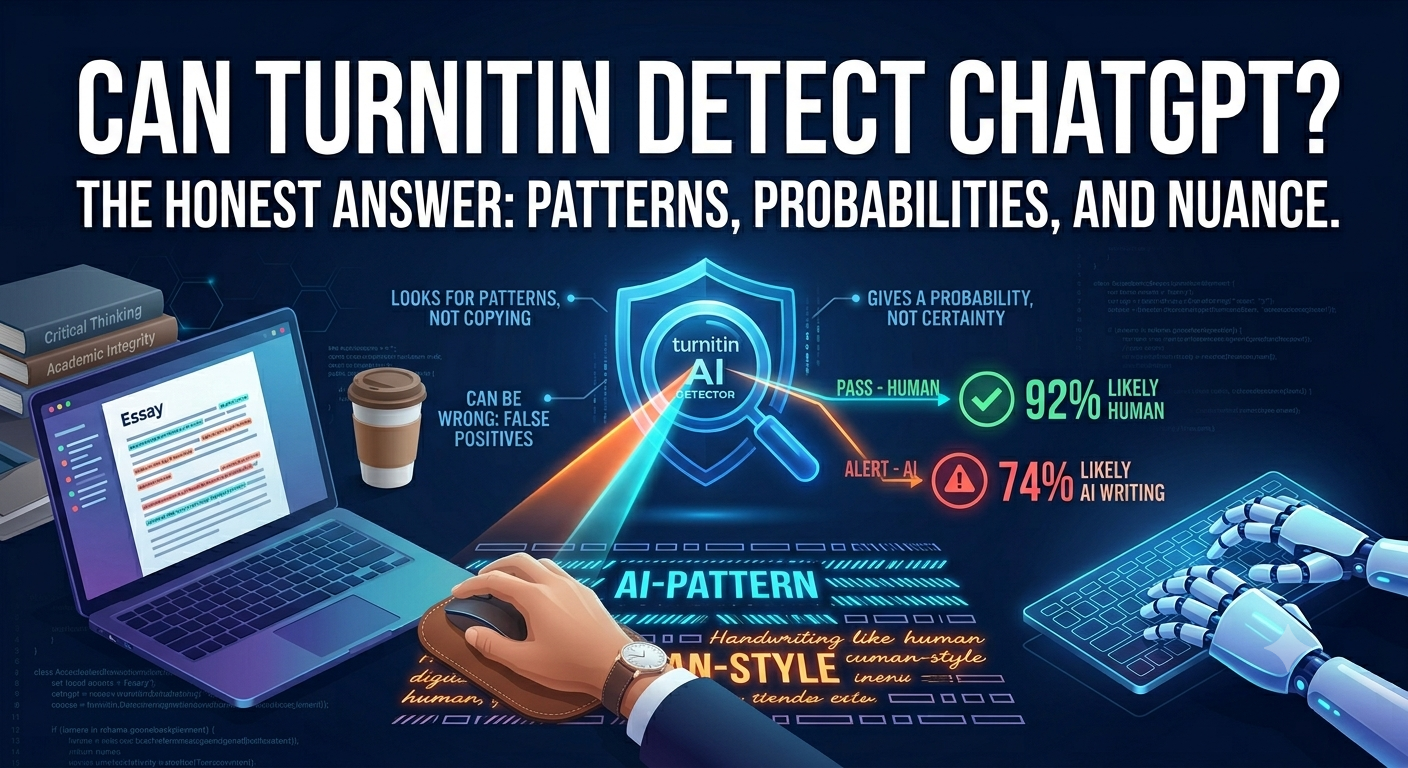
Your Turnitin AI score is an estimate of how much of your writing looks like it was generated by an AI tool such as ChatGPT. A score of 40% means Turnitin’s model thinks about 40% of your qualifying text matches the patterns of AI writing. It is a probability, not proof, and it is completely separate from your similarity score.
That difference matters, because a high AI score does not mean you copied anything. It means the writing style looks like a machine generated to the detector. Sometimes that is right. Sometimes it is a false flag on genuine human writing. This guide explains what every range means and what to actually do about it.
Key takeaways
- The AI score estimates how much of your text reads like AI writing. It is not the same as your similarity score.
- It is a probability, not a verdict. Turnitin itself says it should not be the sole basis for action against a student.
- Scores between 1 and 19% show an asterisk because they are less reliable.
- Real human writing can be flagged, especially if it is formal or formulaic.
- You can check your AI score before submitting to avoid surprises.
What is a Turnitin AI score?
The AI score is the percentage of your qualifying text that Turnitin’s detector believes was likely generated by AI. Turnitin looks at writing patterns, not at a copied source. It studies things like how predictable your word choices are and how much your sentence length varies.
This is why the AI score works differently from the similarity score. Similarity finds text that matches existing documents. The AI detector finds text that statistically resembles how language models write. You can read how the matching side works in our guide on what a good similarity score is.
What does each AI score range mean?
Here is a plain breakdown. We call it the Plag Check AI Read, and it reflects how cautiously these numbers should be treated.
| AI score | What it suggests | How seriously to take it |
| 0% | No qualifying text flagged as AI. | Clear result. |
| 1 to 19% (shown as *) | Possible minor patterns. Low reliability range. | Treat with caution. Often a false flag. |
| 20 to 40% | Some sections resemble AI writing. | Worth reviewing the flagged parts. |
| 41 to 70% | A large share looks like AI generated. | Review carefully and revise in your own voice. |
| 71 to 100% | Most of the text reads as AI generated. | Strong signal. Rework before submitting. |
Keep in mind these are not hard rules. The same essay can score very differently across detectors, because each tool uses its own model. A piece flagged at 60% in one checker might score 10% in another.
Why does my AI score show an asterisk?
Turnitin shows an asterisk for scores between 1 and 19% instead of an exact number. The reason is reliability. Turnitin’s own testing found more false positives in this low range, so it added the asterisk to remind everyone that these results are less dependable.
In short, a low AI flag is not something to panic over. We cover this fully in what the asterisk means on a Turnitin AI score.
What are the two AI categories in the report?
Turnitin splits AI detection into two parts. The first is AI generated text, which the model thinks was likely produced by a language model. The second is text that may have been AI generated and then changed using an AI paraphraser or bypass tool.
Both categories add to your overall AI percentage, and they are highlighted separately in the report. We explain the difference in AI generated versus AI paraphrased.
Why was I flagged as AI when I wrote it myself?
This happens more than you would expect, and it is one of the biggest frustrations students face. The detector is reacting to writing patterns, so genuine human work can trip it.
The 3-Signal AI Flag Test explains what detectors react to:
- Predictability. AI tends to pick the most expected next word. If your writing is very smooth and even, it can look machine made.
- Burstiness. Humans mix short and long sentences. Flat, uniform sentence length can read as AI.
- Fingerprints. Some phrasing and structures show up often in AI text. Formal, formulaic writing can share those traits.
So clear, careful, academic writing can sometimes look like AI to the model. Editing tools like Grammarly or a paraphraser can push the score up too. We dig into Why Turnitin flags human writing as AI.
How accurate is the Turnitin AI detector?
Turnitin is honest that the model is not perfect and can misread human, AI, and AI paraphrased text. The company has stated that false positives are more likely in the low score range, which is why the asterisk exists. Reporting on Turnitin’s own figures has also pointed to a sentence level false positive rate of around 4%, meaning some human sentences get wrongly flagged.
The takeaway is simple. Treat the AI score as a signal that invites a closer look, not a final judgment. We go deeper in how accurate Turnitin AI detection is.
Can Turnitin even detect ChatGPT?
Often yes, but not always. Turnitin can frequently spot ChatGPT style writing because of its patterns, though it can also miss edited AI text and wrongly flag human writing. We answer this in full in can Turnitin detect ChatGPT.
What should I do if my AI score is high?
First, do not panic. A high score is not an automatic accusation. Open the report and read the flagged sections, then revise them in your own natural voice.
The legitimate fix is to write more like yourself. Add your own analysis, vary your sentences, and break up overly smooth, formal passages. We cover the right way to do this in how to lower a high AI score. This is about writing authentically, not about gaming the system.
How can I see my AI score before I submit?
Most students never see their AI score until after submitting, because that report is controlled by the instructor. By then it is too late to revise. We explain the access problem in can students check Turnitin before submitting.
With Plag Check you can see it early. Upload your document and get your full similarity and AI report in about 15 minutes, with no account and no risk of your paper being stored in a university database. Run your check now.
Frequently asked questions
What does a Turnitin AI score mean?
It is the percentage of your text that Turnitin’s model thinks was likely generated by AI. It is an estimate based on writing patterns, not proof of AI use.
Is a 20% AI score bad?
Not necessarily. A 20% score means some sections resemble AI writing and are worth reviewing. It is a prompt to check, not a conclusion.
Why does my AI score have an asterisk?
Turnitin shows an asterisk for scores between 1 and 19% because that range has more false positives and is less reliable.
Can human writing be flagged as AI?
Yes. Formal, smooth, or formulaic writing can be flagged, and editing tools can raise the score. See why human writing gets flagged.
Is the AI score the same as the similarity score?
No. They are two separate numbers. Similarity measures matching text. The AI score measures how much of your writing looks AI generated.